The Knight's Armor


Suits of Armor are more than just metal suits! They evoke a certain medieval feeling - a romantic heroism. And suits of armor were made for function and also for visual effect. These suits evolved and changed dramatically over the centuries of the middle ages.
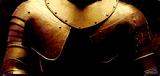
When You think of Medieval Armor you are probably thinking about Platemail. This is the armor shown by the knight in the picture at the top of this page. This platemail was not instantly available to knights of the middle ages. It was the culmination of metalworking arts and blacksmiths knowldge and skill over a period of several centuries. The full suit of armor came from the development of individual pieces over these centuries. Eventually all these pieces were put together into one complete set.
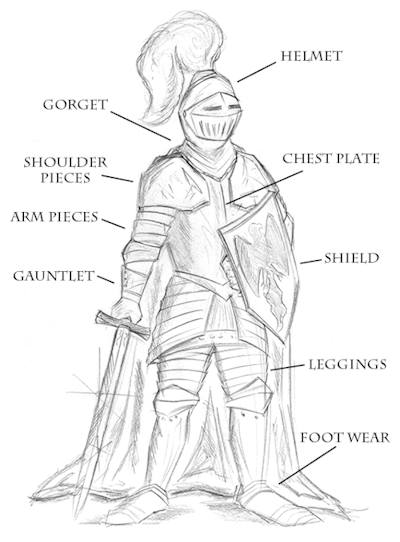
The Major Parts of A Knight's Medieval Armor:
- ChainMail: This is a piece of cloth like armor that was made from interlocking links of chain. It was sometimes worn solely as armor and in the later centuries of the medieval period it was worn under plate armor.
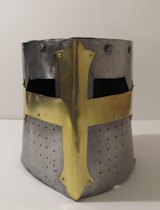
- The helmet: This is the piece that covers the head and face. This piece developed over the centuries being first more like a hat then eventually becoming something called a Bassinet which was almost like a basket that covered all of the head yet kept the face open. Eventually the helmet became a self-contained piece with a visor that could be slid up and down.
- The gorget: This is the piece around the knight's neck. It protected the area of the body between the helmet and the chest piece. These were made from various materials including sheets of metal or chainmail.
- The Chest Plate: This is the most impressive part of the knights armor. It was two pieces of plate molded to fit the knight's body and it was usually in two pieces (front and back() that were buckled together.
- The Shoulder pieces: These could be very specialized with lparts that stuck out as a way to guide weapons away from the body. These shoulder pieces were also sometimes part of the arm pieces.
- Arm pieces: Covered the arms from shoulder to wrist. They had to be flexible at the elbow and were often assembled at this point with multiple sheets that could accordion over each other.
- Gauntlets: These are the gloves that protected the hands and fingers. The fingers were often made of consecutive sheets riveted together much like the shell of an armadillo.
- Leggings: Covered the legs and were jointed at the knees. Leggings were very important to a knight because when he was mounted on his horse his legs were very vulnerable to strikes from opponents on the ground.
- Foot Wear: Was also important to the knight because of its proximity to the opponent on the ground. The foot wear was often made from several sheets of plate jointed together so they could flex and fit into the stirrups.
- The Shield: This was a very important part of a knights protection and shields came in very many shapes and sizes.
Armor changed dramatically over the centuries
The making of armor was an ever changing art and craft. There were many things that affected how it was made including the skill of the armorer and the technology and tools that were available at the time. And it varied from country to country and even from city to city. The major time period for the creation and use of armor was from the 11th century to the 15th century. And it is important to realize that what we think of as suits of armor were something that only came about toward the end of this period. Up until that point armor was only partial. I have an article with pictures that shows the development of armor over this time period. Medieval Armor over the Centuries and how it changed
Here are some pictures and links to typical Knight Armor that you can own.
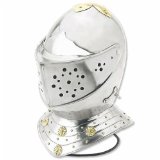
 Etched Knight's Helmet
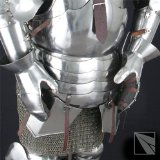
 Milanese Gauntlets Made to protect the hands, Produced in Italy throughout the 15th century, armour of this type incorporates large and smooth glancing surfaces in its construction, the theory being that these rounded surfaces would help to deflect an opponent's weapon. The embossed ridges and fluting that typify armour of the Gothic style are generally absent in Milanese style armour, but that does not change the functionality of this high quality armour.
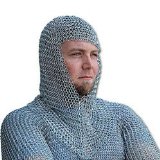
 Chain Mail Coif Medieval Knight Armor
In this particular picture you can see the chest piece and the coif (Which is the part of the chainmail that protects the head and neck).
Resources