|
 |
|
|||||
 |
|||||||
 |
-Knight-Medieval.com-Knights, Castles, Chivalry, siege engines and everything Medieval - -
What was a Medieval knight? Many things come to mind when we think of a knight and the role of the knight has changed over the centuries. But the typical Knight we think of was a man that lived between the 12th and 17th centuries who was pledged to serve his How did somebody Become a Medieval Knight? How did the training for knighthood occur?
For a boy that was born of royalty there was a common process for becoming a knight. At around the age of 8 he would be sent off the to the local lords court to become a page. This meant that he would learn all the necessary things for knighthood, things such as the rules of court, chivaly, writing, music and weapons. Than at around the age of 13 he would become a squire and because he was getting bigger and starting to develop into his manhood his training would focus much more on weapons, horsemanship and combat. One thing that was very seriously focused on was the rules of tactics for horse mounted combat. This was the most essential aspect of combat for a knight. It was this mounted combat that made a knight a feared and respected foe. The Code of Conduct and Chivalry of the Knight It should be noted that this code of chivalry has been highly romanticized in the modern day and wasn't prevalent until the later middle ages. Many scholars say that throughout the centuries there were many knights that were ruthless and bloodthirsty warriors who held no code of conduct except that which benefited themselves. The Decline of Knights Over the centuries knighthood eventually declined to the state they are in now as strictly a title of honor with no real power. The thing that brought about the demise of the knight was technology and this moved in stages. The first stage of decline was the invention of the crossbow and later the arbalest (Which was a very powerful crossbow) these weapons could be wielded by someone with very little training and they were powerful enough to pierce the best armor of a knight. This meant that a knight who had trained all his life in the art of combat could be brought down in the matter of a few seconds by a person with an arbalest and very little training. The Arbalest was declared a dishonorable weapon but it was still used. This technological development was probably enough alone to bring about the fall of the knight but the decline was completed with the development of gunpowder. As guns came into use it was clear the knight stood no chance for no armor could protect against a bullet. Knight Orders of the Past and Present
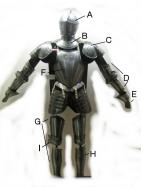
Did you know? Here is some interesting information about the term "Knight". For the most part, and in most countries Knight's were closely related to horses. This is because a knight mounted on a horse was a very dangerous force to be feared. It took wealth to have warhorses for battle. This use of the horse had a big impact on the name knight. In many countries this is reflected in their names. In France a knight was known as a "Chevalier". In Spain he was a "Caballero". In Italy he was a "Cavalier". And in Germany he was a "Ritter". These are all derivates from the word horse or the word to ride. In England we find the exception to this rule where the term "Knight" comes from the anglo-saxon word "cniht" which means household servant or retainer. Many societies didn't have any exposure to horses and when knights on horseback invaded into their territories it evoked terror and many myths such as the centuar from ancient greece. The weapons of the Medieval Knight: Here you can learn about the various typical weapons that a medieval knight wielded from the Mace to the flail, polearms and of course swords. The weapons of the Medieval Knight The Armor of the Medieval Knight : There were many types of armor and they changed throughout the centuries, and varied from country to county. Here is more about the Armor of the Medieval Knight New article: Famous Medieval Knights. Some of these are real and others are just fictional! They are all nonetheless famous
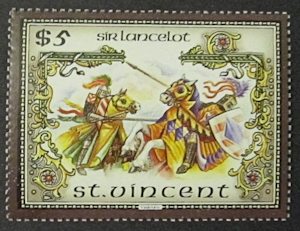
New Article: Some wonderful stamps from the island country of St. Vincent commemorate the Tale and legend of King Arthur. Check out the stamps here.
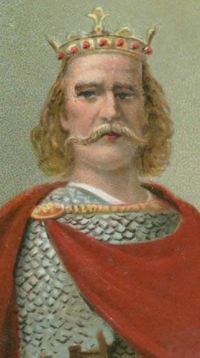
New Article: 1066 is considered to be a pivotal year in History. Before it was the Early middle ages and after it was the High Middle ages. Many things happened in this important year including the Battle of Hastings. Read part 1 of a 4 part series of articles on this important and bloody year: How King Harold and Anglo - Saxon England "fell' into the Bad Fall of 1066
Some New Articles on this website:
|

Custom Search
|
|||||
Copyright©2007-2014 Kalif Publishing - All Rights Reserved | sitemap | xml sitemap |
|||||||
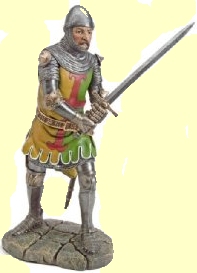
 liege or king in military service. Generally this pledge was termed that the knight would serve 40 days of each year in military combat for his king. In exchange the knight would receive loot from battles, his own estate and position in the King's court.